Villains / The Underframe

The Underframe
Every life is a thread in the Framework. When a thread is cut, it falls through the weave.
Best with headphones.It isn't evil. It's worse.
The Void wants to eat the world. The Underframe doesn't want anything. It's the back of the Framework, the side of the weave nobody was ever meant to see, where every cut thread finishes up. It isn't hell exactly, but it's the nearest thing the universe has, and it's far older than the Rock. It doesn't hate you. It processes you.
The other side of the system
Think of the Framework as the machine that runs the world. The Void is a virus, eating it from outside. The Underframe is the antivirus, cleaning it from underneath. And the antivirus has no mercy. It would rather delete a clean file than let one infected file through.
- The bin
- A cut thread is never deleted at once. It drops into the Underframe, the way a file drops into a bin.
- The count
- While one living person still says your name, you're kept. When the last one stops, nothing points to you any more.
- The scan
- The Scale checks every thread for a trace of the Void. Like every scan, it can't tell a sin from a stain.
- The daemons
- The Weighers. In a real computer, the processes that run in the background, unseen and never stopping, are called daemons. Here they wear grey coats and carry ledgers.
- The reaper
- Death. In a real computer, the process that collects the dead ones is called the reaper. A dead process still waiting to be collected is called a zombie.
- The secure wipe
- The Furnace. What burns there can never be recovered.
Nobody arrives standing
The dead wake face down on a floor of black glass, in whatever they were wearing when they died, still wet, or dusty, or burnt. Under the glass, a long way down, each of them can see their own body exactly where it fell, held in the last second of their life like an insect in amber. Most of them try to break the glass. Nobody ever has.
There is no sky. Overhead hangs the underside of the Framework, dead and grey on this side, and from it dangle thousands upon thousands of cut threads, like roots from the roof of a cave. Some of them still twitch.
Your name
There is no sound. Each new arrival hears their own heartbeat once, very loud, and then never again. After that the only sound is a whisper that never stops, like wind through long grass: every name still being spoken in the living world. While somebody up there still says yours, you can hear it. When the last of them stops, your whisper goes out.
The line
The dead stand in a single line that runs out of sight in both directions. It moves one step every time a clock stops somewhere on Earth. Here and there in the line is a gap where someone should be standing and isn't. Those are Null's. They never arrive, because they were never there to die.
The Scale
At the head of the line hangs the Scale: two plates of black, tarnished brass on chains that rise into the threads. It doesn't weigh hearts and it doesn't weigh sins. It weighs what in a person belongs to the Framework against anything that belongs to the Void. For almost everyone the plates barely move.
The Weighers
The Scale is kept by the Weighers, tall, thin figures in long ash-grey coats who have no faces. Where a face should be there is a smooth oval of old mirror, fogged as if someone has just breathed on it, and anyone who looks into one sees themselves at the moment they died. The Weighers never speak. They write. When a judgement is made, they close the book.
The mirrors
Hundreds of old mirrors hang in the dark above the glass. Each one holds one of the dead at the moment they died. Now and then one of them rushes up to the glass and screams without making a sound.
Death
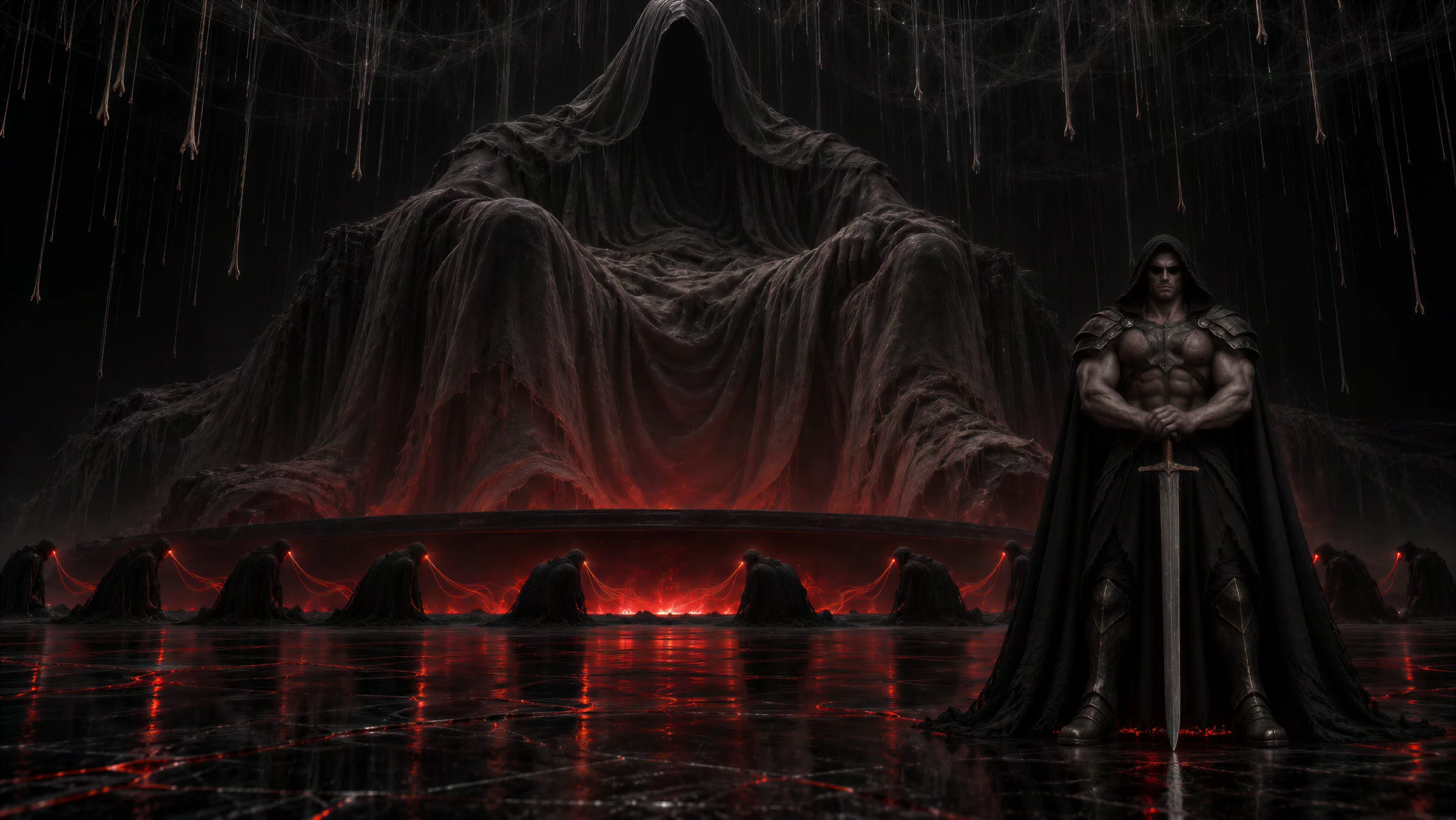
At its centre sits Death. Not a skeleton with a scythe, but a seated figure the size of a cathedral under a heavy grey shroud, so still that the dead who glimpse it take it for a statue. Nobody has ever seen it move. It doesn't need to. When Death wants something, a clock stops somewhere on Earth and one of its servants climbs out of the dark to collect.
Death almost never speaks. When it does, it's the only sound in the Underframe that isn't a whisper: a voice so deep it rides on a hollow horn, like a foghorn sounding from under the sea. You feel it in your chest before you hear the words.
The Furnace
The condemned aren't punished the way people imagine. They're emptied. The Weighers draw a person's memories out through the eyes, as one long thread of red light, and feed it into the Furnace at Death's feet. That's the low oxblood glow under the glass. The whole Underframe is lit by burning memories.
Its servants
What's left is remade for service. The skin hardens and cracks like weathered stone, heavy plates grow out of the bone, and the servant is dressed in a hood and cloak cut from the same dark cloth as the Weighers' coats. Then it's sent back up, to collect the dead and to drag back anyone who tries to slip away.
Meet SerdnaThe rules
- Nothing living can enter.
- Time doesn't pass, so the dead never sleep, never age and never forget, until they're emptied.
- Mirrors show only the moment of death.
- The Furnace burns memories, never people.
- Every clock that stops on Earth moves the line one step.
- Nothing in the Underframe hurries.
On the Rock nobody has a name for it. But the men who dug the deepest wartime tunnels used to say that on cold nights, if you put your ear to the stone right at the bottom, you could hear pens scratching.
Back to the light