Fusion Laboratories
A small private research company on the Rock, chasing the energy of the stars since 1958. On paper it studies clean power. Underneath, it keeps something it cannot explain.
- Founded
- 1958
- People
- 22, including 10 scientists
- Director
- Professor Hector Lyall
- Field
- Fusion energy and plasma physics
- Reactor
- The Ring, first plasma in 1974
- Site
- The Assembly Hall, and three levels below
A short history
Fusion Laboratories opened in 1958, the year the world's governments stopped keeping fusion research secret and shared it at a conference in Geneva. It began with six people in a converted wartime storehouse and one borrowed electromagnet. Professor Hector Lyall arrived as director in 1966 and has run the place ever since.
When the frontier with Spain closed in 1969, the company nearly went with it. For thirteen years parts and people came in by ferry from Tangier, and the staff learned to fix almost anything themselves. That habit is still the first thing new arrivals notice.
What they study
Fusion's physicists chase the same promise as every fusion lab of their day: the power of the sun, made safely on Earth. They build magnetic bottles for gas hotter than the core of the sun, test metals that have to survive that heat, and write the software that stops it all tearing itself apart. The annual report talks about clean power for a small territory. Most of that is true.
The Ring
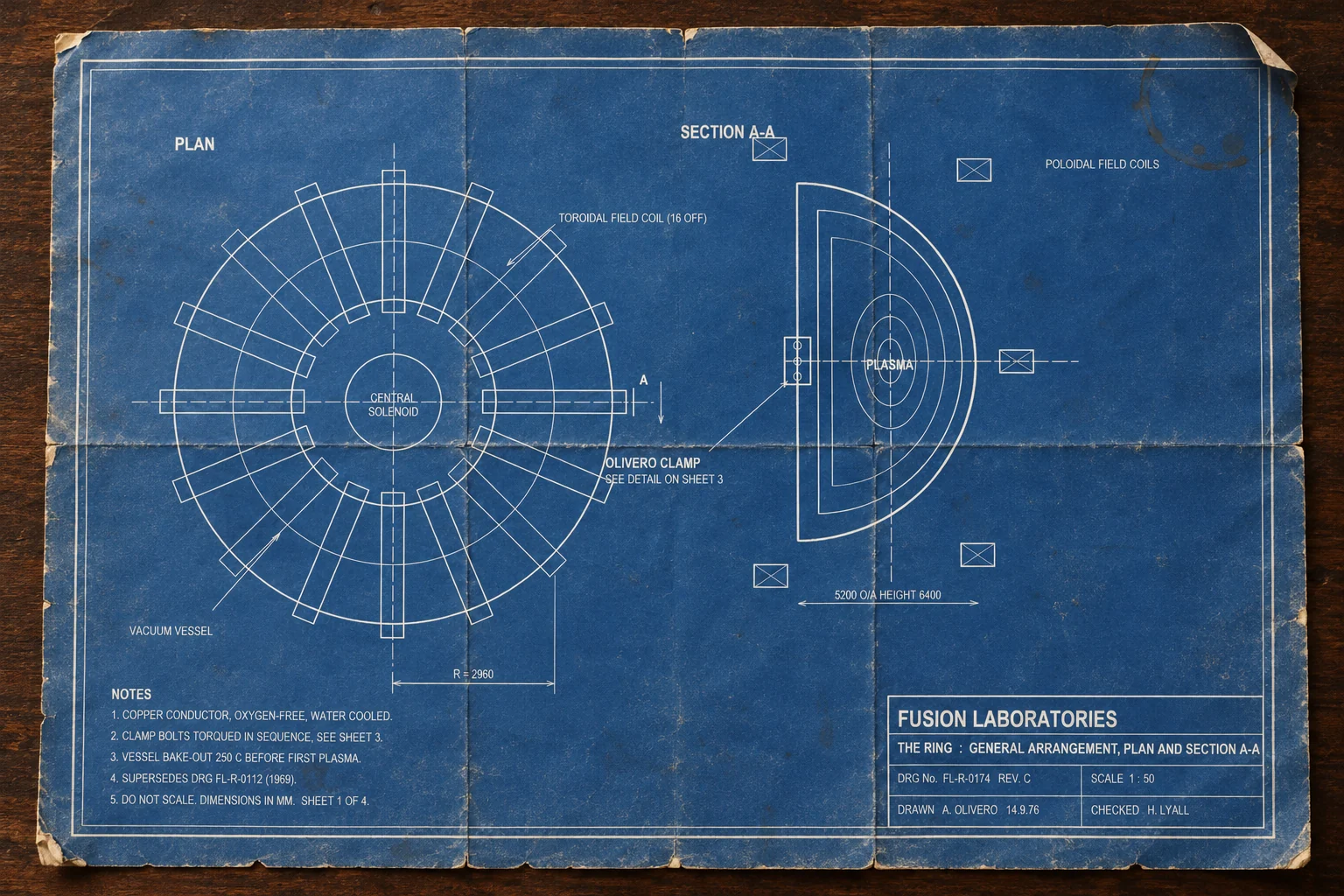
The Ring is Fusion's reactor, a doughnut of steel and copper coils taller than a house, built inside the Assembly Hall, the biggest building on the site. It took six years to assemble and made its first plasma in 1974. Staff talk about it the way sailors talk about a ship: it has moods, it has good nights, and on the bad ones nobody goes home.
The anniversary photograph
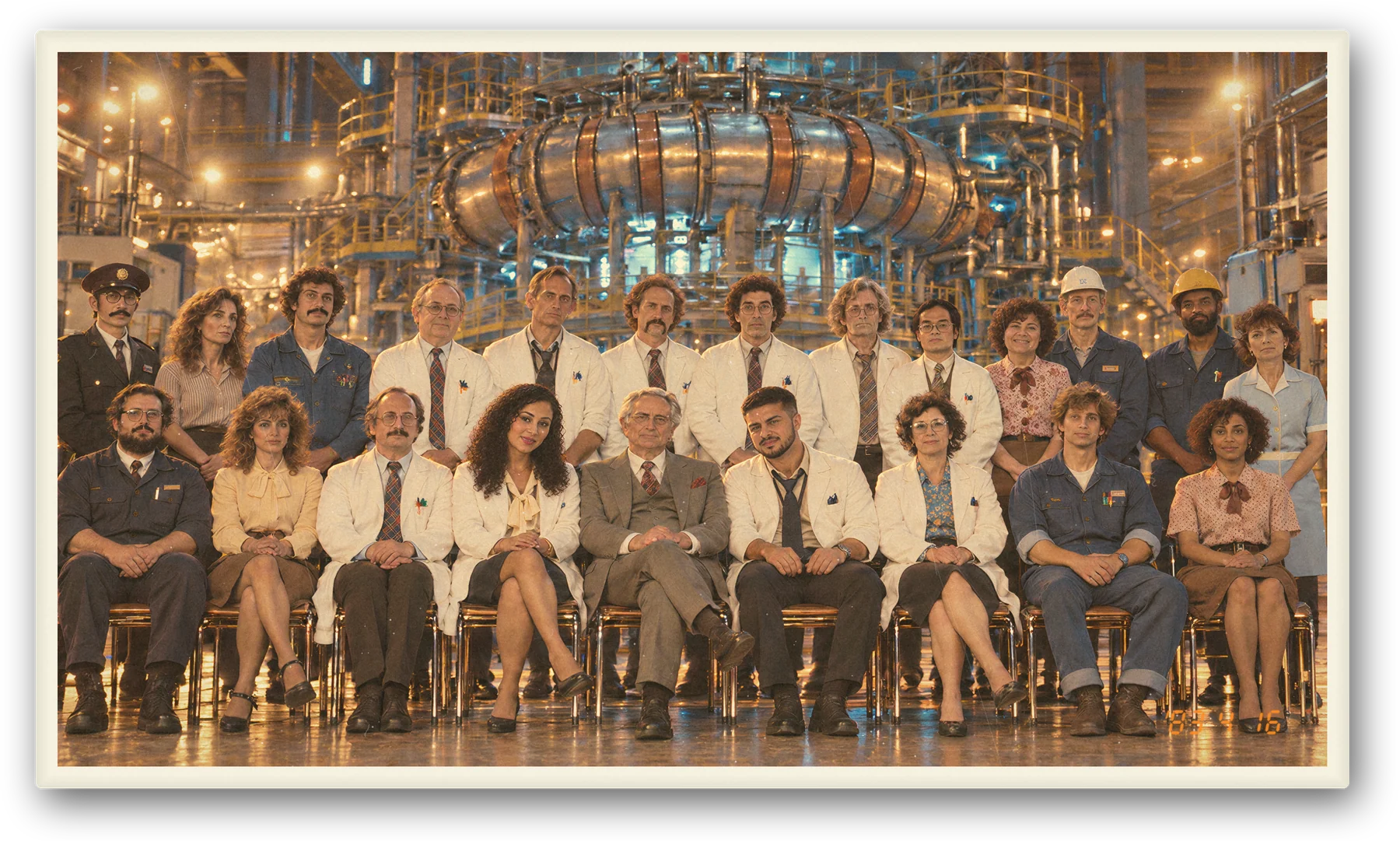
On 16 April 1983, for the company's 25th anniversary, Professor Lyall had everyone stop work and line up in front of the Ring. Scientists, engineers, technicians, secretaries, the security guard and the cleaners: all twenty-two of them. It is the only all-staff photograph Fusion has ever taken, which is why there is no picture from the year before, or the year after.
What they keep
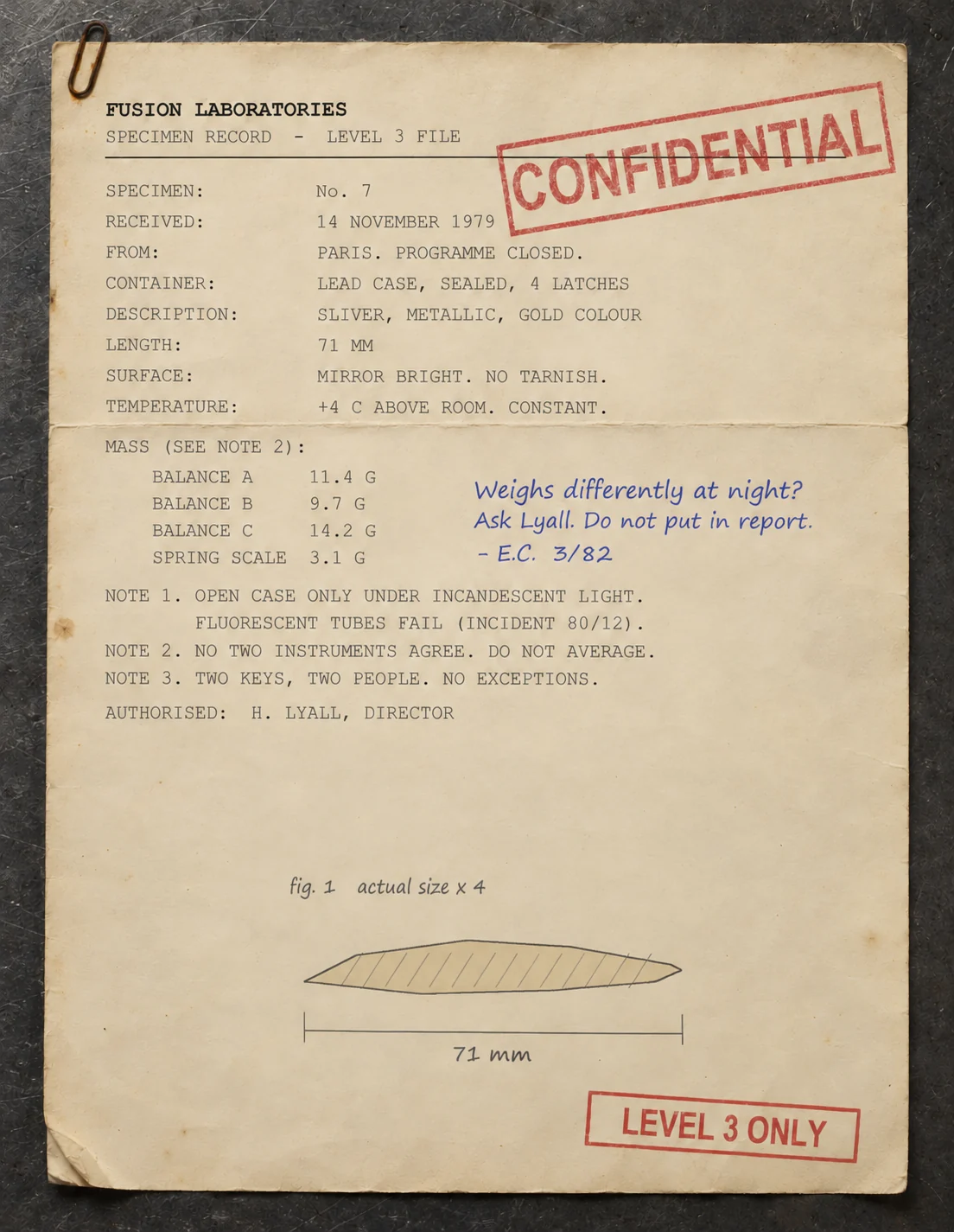
In 1979 a sealed lead case arrived from a research programme in Paris that had shut down without warning. Inside is Specimen 7, a sliver of gold no longer than a finger, so bright that the first people to see it thought it was a piece of the sun. No two instruments agree on what it weighs. It stays warm on cold nights, and the staff who have worked near it say the lights flicker when the case is opened. Fusion has never published a word about it.
Where it is kept
Below the public labs, the site runs down into old wartime tunnels cut deep into the limestone. The paperwork says Specimen 7 is stored on Level 3, the lowest floor, in a lead-lined vault that needs two keys and two people to open. Officially, Level 3 holds archive boxes. Nobody below a senior grade has been past its door.
Timeline
- 1958Fusion Laboratories opens with six staff.
- 1962The first magnetic bottle holds plasma for a hundredth of a second.
- 1966Professor Hector Lyall becomes director. A founding physicist leaves for Paris.
- 1968Work starts on the Ring and the Assembly Hall.
- 1969The frontier with Spain closes. Supplies come by ferry from Tangier.
- 1974The Ring makes its first plasma.
- 1979A sealed lead case arrives from Paris.
- 1982The Ring holds a stable plasma for more than a second.
- 1983The company turns 25. The anniversary photograph is taken.